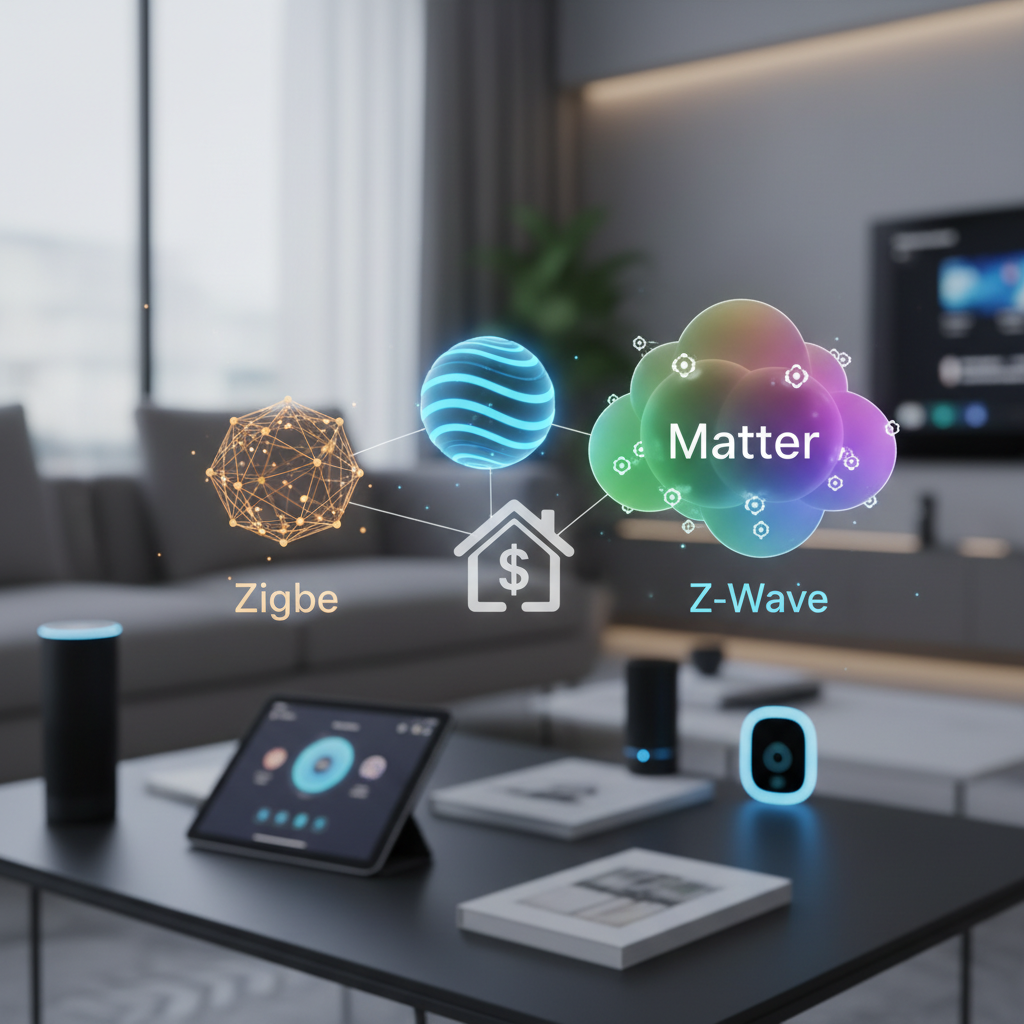
Beyond the Hype: The Financial Reality of Smart Home Protocols
The allure of a perfectly synchronized smart home—lights dimming on command, thermostats adjusting intelligently, security at your fingertips—is powerful. Yet, beneath the promise of seamless living often lurk hidden complexities and potential financial pitfalls. Many homeowners discover that unforeseen issues can lead to frustration and unexpected expenses, a reality discussed by Consumer Reports on smart home device problems.
At the core of these interconnected ecosystems are the underlying smart home protocols: Zigbee vs Z-Wave vs Matter. This article goes beyond superficial features to analyze the profound financial implications of choosing one over the others. We’ll uncover how your protocol decision directly influences ecosystem lock-in, strengthens vendor reliance, and ultimately dictates your smart home upgrade costs and overall long-term costs. Understanding these factors, along with aspects of data control smart home and technological flexibility, is crucial to truly future-proof your smart home and your wallet. Our goal is to empower you with the knowledge to make strategic, financially astute decisions that transcend initial hype. Let’s start by demystifying what these connectivity standards actually entail.
Demystifying Smart Home Connectivity Standards
At the core of any functional smart home lies its smart home connectivity, dictating how seamlessly your devices communicate. While common wireless protocols like Wi-Fi and Bluetooth play a role, many dedicated IoT communication devices rely on a more specialized approach: the mesh network. Unlike traditional hub-and-spoke setups, a mesh network allows each device to act as a repeater, extending the signal’s range and boosting overall system reliability and scalability. For a deeper dive into how this architecture benefits your home, explore what a mesh network is.
This decentralized method is a key reason why dedicated smart home standards often outperform Wi-Fi for many small sensors and actuators, offering lower power consumption and less congestion on your main network. These specialized protocols typically operate on different frequency bands—some, like Wi-Fi, often use 2.4GHz (good penetration, shorter range), while others utilize sub-1GHz frequencies (longer range, less interference). Understanding these underlying technologies provides the crucial context before we examine specific protocols like Zigbee.
Zigbee: Balancing Openness with Device Diversity
When considering dedicated smart home protocols, the Zigbee protocol often comes to mind first, renowned for its roots as an open standard. Technically speaking, Zigbee builds upon the robust IEEE 802.15.4 standard, operating primarily on the crowded yet pervasive 2.4GHz frequency band. Like the mesh networks we discussed earlier, Zigbee mesh network devices don’t just communicate directly with a central hub; they can also relay messages to each other, significantly extending the network’s reach and enhancing reliability throughout your home. This architecture makes it ideal for a low-power smart home ecosystem, enabling many Zigbee devices to run for years on small batteries.
The appeal of Zigbee is multifaceted. As an open standard smart home solution, it boasts a truly vast and diverse device ecosystem, meaning you’ll find everything from light bulbs and motion sensors to smart locks and thermostats across numerous brands. This encourages a highly competitive market, often leading to generally cost-effective hardware. However, this openness isn’t without its quirks. Despite its standardized foundation, Zigbee interoperability can sometimes be a challenge due to varying manufacturer implementations, profiles, and clusters. Additionally, operating on 2.4GHz means Zigbee can be susceptible to interference from Wi-Fi networks and other wireless devices, and it almost always requires a dedicated Zigbee hub to translate its signals for your main network and the internet. For more details on its technical underpinnings, you can visit the CSA-IoT Zigbee resource page.
Financially, the broad availability and competition typically result in a lower initial smart home device cost for individual Zigbee components. While the necessity of a dedicated hub adds an upfront expense and introduces a potential risk of “hub lock-in” to a specific manufacturer’s ecosystem, the sheer diversity of devices can offer greater flexibility in mixing and matching brands when profiles align. This competitive pricing and extensive device selection can also help mitigate future upgrade costs, provided the standard remains well-supported and widely adopted.
As we’ve seen, Zigbee offers compelling advantages, particularly in cost and device variety. However, its approach to interoperability and ecosystem management differs significantly from other protocols. Next, let’s explore Z-Wave, which offers an alternative vision for stability, security, and a more curated device experience.
Z-Wave: Stability, Security, and Curated Ecosystems
Shifting gears from Zigbee’s broad appeal, the Z-Wave protocol presents a distinctly different vision for your smart home: one built on stability, robust Z-Wave security, and a more controlled, curated ecosystem. Instead of sharing the crowded 2.4GHz band, Z-Wave devices operate on sub-1GHz frequencies (which vary by region). This strategic choice significantly reduces interference from common household devices like Wi-Fi routers and microwaves, contributing to superior smart home reliability. Like Zigbee, it forms a robust mesh network, extending the reach and strength of your smart home signals across your property.
A cornerstone of the Z-Wave experience is the strict certification process mandated by the Z-Wave Alliance for all Z-Wave devices. This rigorous standard ensures a strong interoperability guarantee across brands, meaning any Z-Wave device displaying the logo should seamlessly integrate with your Z-Wave hub and other components. While this level of scrutiny translates to generally higher hardware costs per device and a smaller ecosystem compared to Zigbee’s vast selection, the trade-off is often a more dependable and headache-free setup. Data rates tend to be slower than some alternatives, but for most smart home commands (like turning lights on/off or adjusting thermostats), this isn’t a noticeable limitation. A dedicated hub is still a requirement for most Z-Wave setups, much like Zigbee.
From a financial perspective, the higher initial investment per Z-Wave device is often offset by reduced integration headaches and lower long-term troubleshooting costs due to that guaranteed interoperability. Your smart home investment gains a layer of predictability. While vendor choice Z-Wave might feel more limited, the focus on quality and security can lead to a more stable experience. Future upgrade costs are heavily influenced by the Z-Wave Alliance roadmap and their continuous certification updates, ensuring your existing devices remain relevant within the ecosystem. As you consider these protocols, it’s clear each brings a unique set of trade-offs, leading us to examine the newest player on the block: Matter, which aims to redefine interoperability entirely. For more information on Z-Wave’s standards and benefits, visit the Z-Wave Alliance.
Matter: A New Era of Interoperability and Flexibility
After dissecting the established landscapes of Zigbee and Z-Wave, it’s time to turn our attention to the disruptor aiming to unify the smart home universe: Matter. Spearheaded by the Connectivity Standards Alliance (CSA), the Matter protocol is built on familiar IP (Internet Protocol) foundations, cleverly leveraging existing, robust technologies like Wi-Fi, Thread, and Ethernet. Its ambitious goal is nothing less than universal smart home interoperability across virtually every brand and ecosystem, moving beyond the traditional silos we’ve come to expect.
The potential advantages of Matter are profound for consumers. Designed from the ground up for true multi-vendor compatibility, it promises to drastically simplify device setup and reduce reliance on proprietary hubs. Instead, it utilizes “border routers” – often built into existing devices like Wi-Fi routers or smart displays – to bridge the Thread network and other protocols. This emphasis extends to local control smart home operation, meaning many devices can function without constant cloud reliance, boosting both responsiveness and smart home data privacy Matter. Enhanced security features are also baked into its core, reflecting lessons learned from previous generations.
However, as with any nascent technology, Matter isn’t without its challenges. It’s still in the early stages of adoption and maturity, meaning consumers might encounter initial fragmentation or confusion during its rollout. Understanding how “Matter over Thread” or “Matter over Wi-Fi” functions, and which devices best serve as border routers, will be key learning curves. The industry is rapidly developing, but full widespread compatibility will take time to materialize.
From a financial and flexibility standpoint, Matter represents a significant paradigm shift. It promises to drastically reduce vendor lock-in reduction, freeing consumers to choose the best device for their needs regardless of brand. This increased cross-brand compatibility could lead to lower future upgrade costs, as new devices are more likely to integrate seamlessly with your existing setup, preserving your investments. Furthermore, greater market competition driven by this universal standard could result in more competitive pricing across the board. For savvy investors in smart home tech, strategically investing in Matter-compatible devices now is a move towards a truly future-proof smart home and long-term value. This newfound flexibility in device choice and data control marks a pivotal moment, shifting power back to the user and away from proprietary systems. But how do you navigate these choices to truly avoid being boxed in?
Avoiding the Smart Home Straitjacket: Strategies for Long-Term Value
The allure of a fully integrated smart home can quickly turn into a technological straitjacket if you’re not careful. This predicament, often called ecosystem lock-in or vendor lock-in, means committing to one brand’s proprietary system, from their specific hubs to their cloud services, often rendering devices from other manufacturers incompatible. Such proprietary smart home systems can lead to significant financial and technological headaches down the line.
Financially, this can translate into expensive forced upgrades when new generations arrive, limited competitive pricing due to reduced choice, and even recurring subscription fees just to maintain basic functionality. The potential for replacement costs if a favored company pivots or fails further erodes your long-term value, negating the very purpose of smart investments. Understanding how to avoid vendor lock-in is crucial for any platform, especially in your home.
Beyond the wallet, the technological costs include reduced choice, stifled innovation as a single vendor dictates features, and significant smart home data control concerns, as your data resides centrally with one company. To avoid this trap and ensure technological flexibility, prioritize open standards smart home protocols like Matter and Zigbee. Seek out multi-protocol hubs that can bridge different technologies, and always opt for devices offering robust local control smart home capabilities, reducing reliance on cloud services. Researching a company’s longevity and commitment to open standards is also key to reduce upgrade costs and secure financial flexibility smart home.
Matter, with its focus on universal compatibility, represents a significant leap towards dismantling these traditional barriers, offering a true path out of smart home vendor reliance. By strategically investing in devices that champion these principles, you empower your home with adaptability, security, and long-term value. Now that we’ve explored the perils of lock-in and strategies to avoid it, let’s dive into the specifics of how Zigbee, Z-Wave, and Matter stack up, helping you decide which protocol is right for your unique smart home vision.
Which Protocol is Right For You? A Strategic Guide
Now, let’s translate those principles into a concrete smart home decision guide for choosing smart home protocol. First, assess your current smart home setup: do you have existing Zigbee, Z-Wave, or Wi-Fi devices? This immediately informs your smart home budget and potential upgrade paths. Consider your smart home interoperability needs: how vital is it to seamlessly integrate devices from various manufacturers? If maximum flexibility is your goal, then Matter, despite its youth, is a strong contender for a future-proof smart home.
For those prioritizing data privacy smart home and robust local control, both Zigbee and Z-Wave offer established ecosystems. Z-Wave often appeals to users with high smart home security needs due to its dedicated frequency, while Zigbee boasts a wider, often more affordable, device selection. When weighing long-term costs, factor in not just initial hardware, but also potential replacement cycles and the overall smart home investment strategy.
For many, the sweet spot lies in a multi-protocol hub. This versatile device acts as a bridge, allowing you to leverage existing Zigbee or Z-Wave devices while future-proofing with Matter compatibility. This approach provides financial flexibility and hedges against technological obsolescence. For a broader look at various smart home devices and ecosystems as you refine your strategy, consider The Verge’s guide to best smart home devices. Ultimately, making the right choice now is about empowering your smart home and securing its future value.
Empowering Your Smart Home, Securing Your Future
Ultimately, the ‘best’ smart home protocol isn’t a universal truth; it’s a strategic decision tailored to your individual priorities. Your smart home isn’t just a collection of gadgets; it’s a significant smart home investment, one whose long-term value smart home, operating costs, and adaptability hinge directly on your chosen communication backbone. While Matter promises unparalleled interoperability and a future-proof foundation, the robust ecosystems of Zigbee and Z-Wave continue to offer reliable, cost-effective solutions. Prioritizing open standards, local control, and diversified ecosystems is key to financial flexibility smart home and crucial vendor lock-in prevention. As the global smart home market continues its rapid ascent, projected to exceed a quarter-trillion dollars annually according to Statista, making a strategic smart home choice today safeguards your future and your wallet.

Senior technology analyst covering enterprise software, AI, and digital transformation. James has spent over a decade helping business leaders understand how emerging tech reshapes competitive strategy.