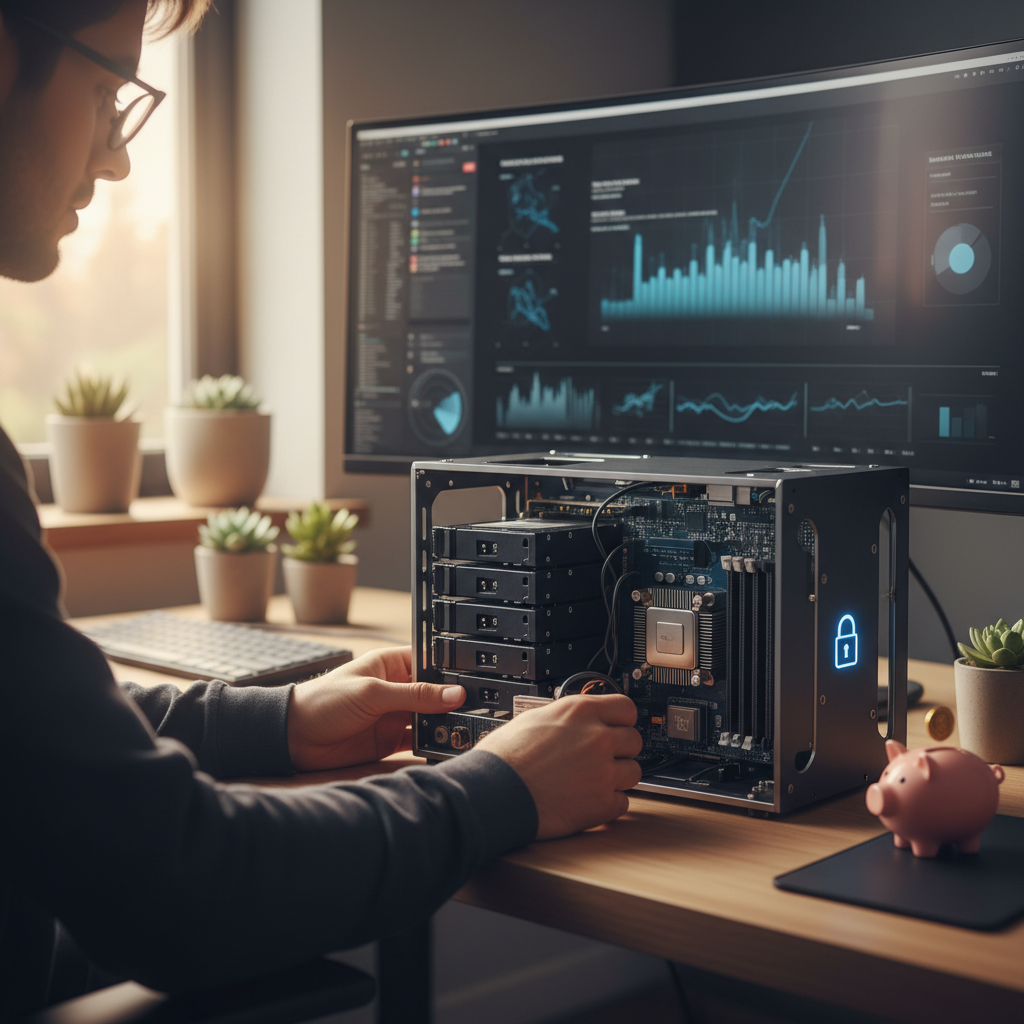
Why Build Your Own Personal Cloud? The Financial and Privacy Imperative
Why bother constructing your own digital fortress when commercial options abound? The answer lies at the intersection of two critical modern concerns: your wallet and your personal data. When you look closely at the true cost and inherent risks of relying on services like Google Drive, Dropbox, or iCloud, the imperative to build a personal cloud storage server becomes strikingly clear.
Consider the cumulative burden of recurring subscription fees. While a few dollars a month might seem negligible, these charges quickly add up. Over three to five years, those monthly payments transform into a substantial sum, often far exceeding the initial outlay for a DIY solution. This is where personal cloud server cost savings truly shine; an upfront hardware investment amortizes over time, leading to significant long-term cost savings compared to endlessly renting digital space.
Beyond the financial calculus, the most compelling argument for a personal cloud is data privacy and security. Every byte you entrust to a third-party provider is subject to their terms of service, their security protocols, and potential data breaches. Building a personal cloud provides unparalleled control, placing your sensitive information firmly within your own domain. This fundamental shift ushers in digital sovereignty home server benefits, making you immune to changing corporate policies, price hikes, or privacy intrusions. You own your data, outright.
Furthermore, a DIY setup offers incredible customization and flexibility. Unlike rigid commercial plans, you can tailor storage capacity, integrate specific apps like Nextcloud for home users, and define access permissions precisely for your household’s unique needs, unlocking true DIY cloud storage benefits and enhanced personal data security. This level of personalized control is simply not available in off-the-shelf solutions.
As we delve deeper, we’ll quantify just how these advantages translate into tangible savings and enhanced security, by putting the personal cloud server cost savings to the test against the commercial giants.
Understanding the Investment: DIY vs. Commercial Cloud Cost Analysis
Moving beyond the philosophical benefits of data sovereignty, let’s dive into the quantifiable financial upside of building your own personal cloud storage server. Many assume the cost of building a personal cloud is prohibitive, but a detailed analysis often reveals the opposite, especially when viewed as a long-term investment. Your initial outlay for a DIY setup primarily comprises one-time hardware purchases: a reliable NAS enclosure or a power-efficient mini PC (like a Raspberry Pi or an Intel NUC), alongside the crucial hard drives. These are capital expenditures, not recurring bills.
To truly compare, we must look at the total cost of ownership (TCO). For your self-hosted solution, this includes the upfront hardware, a negligible amount for electricity consumption (especially with modern, low-power components), and perhaps a small allowance for future drive upgrades or infrequent maintenance over a 3-5 year period. Contrast this with the perpetual subscription model of commercial services. Providers like Google Drive, Dropbox, or OneDrive charge recurring monthly or annual fees that, while seemingly small initially for 1TB or 2TB, quickly escalate for larger capacities and compound significantly over multiple years. For example, storing 5TB or 10TB with a major cloud provider can run hundreds of dollars annually, quickly surpassing the initial cost of building a personal cloud within just a few years. For a deeper dive into how these commercial costs stack up, consider exploring various Cloud Storage Pricing Guides.
This recurring expenditure is where the personal cloud server cost savings truly shine. After your initial hardware investment, your costs remain minimal, transforming those continuous subscription payments into long-term savings. Beyond the direct monetary comparison, the investment in data privacy and peace of mind offer an intangible, yet profoundly valuable, return that commercial services simply cannot replicate. Furthermore, scaling your DIY storage by simply adding another hard drive is often far more cost-effective than upgrading to the next, much pricier tier with a commercial provider. This makes your personal server a dynamic and financially savvy alternatives to subscription cloud storage.
Now that we’ve outlined the financial rationale, let’s explore the tangible components that bring this investment to life.
Essential Components: What You’ll Need to Build Your Personal Cloud Server
Building your own home data server setup begins with selecting the right DIY cloud components. Your hardware for personal cloud can range from a dedicated network attached storage (NAS) for home device for simplicity, to repurposing an old mini PC or desktop for budget flexibility, or even a low-power Raspberry Pi for lighter uses. Crucially, you’ll need reliable storage drives; HDDs for bulk capacity, or SSDs for speed. To protect your data, implement basic RAID configurations like RAID 1 (mirroring) or RAID 5 (striping with parity) for redundancy.
A stable wired Ethernet connection is vital for robust data transfer, linking your server to your router (consider a static IP for easier access). For the operating system, Linux distributions like Ubuntu Server or Debian are popular, alongside specialized NAS OS options such as TrueNAS CORE. The core of your private cloud will be its software. Open source cloud storage solutions like Nextcloud for home users offer a comprehensive suite beyond just file sync, including calendars and contacts, making it highly versatile. OwnCloud is another strong alternative. For a deeper dive into these options, this ultimate beginner’s guide to setting up private cloud storage offers additional context. Once these essential pieces are gathered, you’re ready to lay the physical groundwork.
Step-by-Step Guide: Setting Up Your Hardware Foundation
You’ve gathered your components; now it’s time to bring your vision to life by laying the physical groundwork for your server. Before you dive in, take a moment to confirm your chosen base system—whether it’s a dedicated NAS appliance, a repurposed PC, or a compact single-board computer (SBC)—as this will subtly influence the assembly process.
Begin your DIY server hardware journey by carefully installing your chosen storage drives. If you’re using a PC tower or NAS enclosure, secure your hard drives into their respective bays, connecting both the SATA data and power cables. Ensure all connections are firm. Next, connect the main power supply unit to your motherboard and any other necessary components, and plug in your network cable (RJ45) for essential connectivity.
With everything physically connected, power up your machine and immediately access the BIOS/UEFI settings (usually F2, Del, or F10 during boot). Here, your primary task is to adjust the boot order, ensuring your server will first attempt to load from your chosen OS installation media – typically a USB drive or a CD/DVD drive. Save your changes and exit.
Next comes the server OS installation. Insert your USB drive or disc containing your preferred operating system – be it a robust Linux distribution like Ubuntu Server or a specialized NAS OS like TrueNAS CORE. Follow the on-screen prompts for disk partitioning and user creation. This process is crucial for establishing the backbone of your home data server setup, truly beginning to build a personal cloud storage server.
Post-installation, log into your new server and tackle basic network configuration. Assigning a static IP address to your hardware for personal cloud within your local network is highly recommended. This ensures consistent access and easier management, a key step in any robust NAS setup guide. For those looking for a comprehensive guide on setting up a secure server, this resource on how to build a free, secure, and unlimited personal cloud offers valuable insights.
With your physical server assembled, operating system installed, and network configured, you’ve established a solid foundation. Now, the real magic begins: bringing your cloud to life with powerful software.
Step-by-Step Guide: Installing Your Personal Cloud Software (e.g., Nextcloud)
With your hardware humming and operating system installed, the next crucial step in your journey to build a personal cloud storage server is bringing it to life with powerful software. Before diving into your chosen private cloud software, you’ll likely need a robust web server environment. This typically means setting up a LAMP (Linux, Apache, MySQL/MariaDB, PHP) or LEMP (Linux, Nginx, MySQL/MariaDB, PHP) stack on your server, which provides the necessary components for your cloud application to run effectively.
Once your server foundation is ready, it’s time for the core personal cloud software setup. For many, Nextcloud stands out as a premier example of open source cloud storage solutions. Its Nextcloud installation can be approached in a few ways: following the detailed official installation guides for a custom setup, or opting for simpler, containerized deployments via Docker or Snap packages, which streamline the process considerably. For home users looking to leverage Nextcloud’s capabilities, their dedicated page offers excellent starting points and resources: Nextcloud for home users.
After installing the application, the initial configuration wizard will guide you through crucial steps. You’ll create your admin user, specify the data directory where your files will reside, and connect Nextcloud to its database. This involves configuring your web server (Apache or Nginx) to properly serve the Nextcloud application and creating the necessary database and user credentials (e.g., in MySQL or MariaDB) for Nextcloud to store its internal data. With these steps completed, verify local access by navigating to your server’s static IP address from a browser on a device within your home network. A successful login confirms your self-hosted cloud storage guide is well on its way.
With your personal cloud now accessible, albeit locally, the next critical phase involves fortifying its defenses. You’re building a digital fortress, and security is paramount.
Securing Your Digital Fortress: Best Practices for Personal Cloud Security
With your self-hosted cloud operational, securing it is non-negotiable for true data privacy personal cloud ownership. Start with the basics: implement strong, unique passwords for every user account, especially your admin, and mandate Two-Factor Authentication (2FA) across the board. This foundational step significantly boosts your personal data security. Next, configure your home server security firewall meticulously. Only open ports absolutely essential for your cloud service (typically 80/443 for web traffic) and deny all others to prevent unauthorized access.
Maintaining secure cloud storage requires vigilance. Regularly update your operating system, Nextcloud software, and any underlying dependencies. Patches often contain critical security fixes, making consistent updates a cornerstone of private cloud security. For robust protection, encrypt your data at rest by enabling disk encryption on your server drives. Additionally, secure data in transit with SSL/TLS certificates (e.g., Let’s Encrypt) to ensure encrypted connections for all access. When it comes to remote access, ditch direct port forwarding. Instead, use a Virtual Private Network (VPN) or a properly configured reverse proxy with strong authentication, safeguarding your digital sovereignty.
Beyond preventative measures, a robust backup strategy is paramount. Adhere to the ‘3-2-1 rule’: maintain at least three copies of your critical data, store them on two different types of media, and keep one copy offsite. This safeguards against hardware failure or data corruption. Finally, enable intrusion detection and regularly review server logs. Monitoring for suspicious login attempts or unusual activity is crucial for identifying and responding to potential threats. For further insights into maximizing your security, explore resources like Charleston Southern University’s guide on building a free, secure, and unlimited personal cloud here. Once your digital fortress is impenetrable, we’ll turn our attention to the ongoing task of managing and expanding your personal cloud for longevity.
Managing and Expanding Your Personal Cloud for Longevity
Once your personal cloud is operational, proactive personal cloud management is crucial to maximize your investment. Begin by mastering user management: configure individual accounts for family members, define granular sharing permissions, and organize user groups for streamlined access. As your digital footprint expands, you’ll eventually need to expand home server storage. This often involves adding new hard drives, extending your existing RAID volumes, or migrating to larger storage solutions, effectively scaling personal cloud capacity as needed.
Continuous monitoring is vital for DIY cloud maintenance. Utilize tools to track disk usage, CPU load, RAM utilization, and network performance. Resources like How to Monitor Your Server’s Performance offer excellent guidance. Establish regular maintenance routines, including scheduled disk checks, timely software and firmware updates, and reviewing system logs for any proactive issue detection. For optimizing personal cloud speed and responsiveness, explore caching strategies, network tweaks, and efficient server resource allocation. Finally, elevate your home data server setup by integrating services like calendar/contact syncing, media streaming, or collaborative document editing. While these steps pave the way for long-term success, be mindful that managing your own cloud can present its unique set of challenges.
Potential Challenges and How to Overcome Them
Building your personal cloud storage server will undoubtedly present some DIY cloud challenges. The initial setup involves a learning curve and a time investment. Embrace patience, online communities, and detailed tutorials to navigate this, setting realistic expectations.
Personal cloud power consumption is a common concern. Mitigate it by selecting energy-efficient hardware like SBCs and optimizing server idle states. Adequate internet upload speed is also vital for smooth remote access and sharing, especially with large files.
Don’t underestimate hardware failures. A robust RAID configuration and diversified backup strategy are essential. For self-hosted cloud issues and the Linux administration learning curve, a ‘learn by doing’ approach is best. Resources like The Linux Command Line: A Complete Introduction offer excellent server management tips, making home server troubleshooting less intimidating. Overcoming server challenges will build valuable expertise.

Senior technology analyst covering enterprise software, AI, and digital transformation. James has spent over a decade helping business leaders understand how emerging tech reshapes competitive strategy.