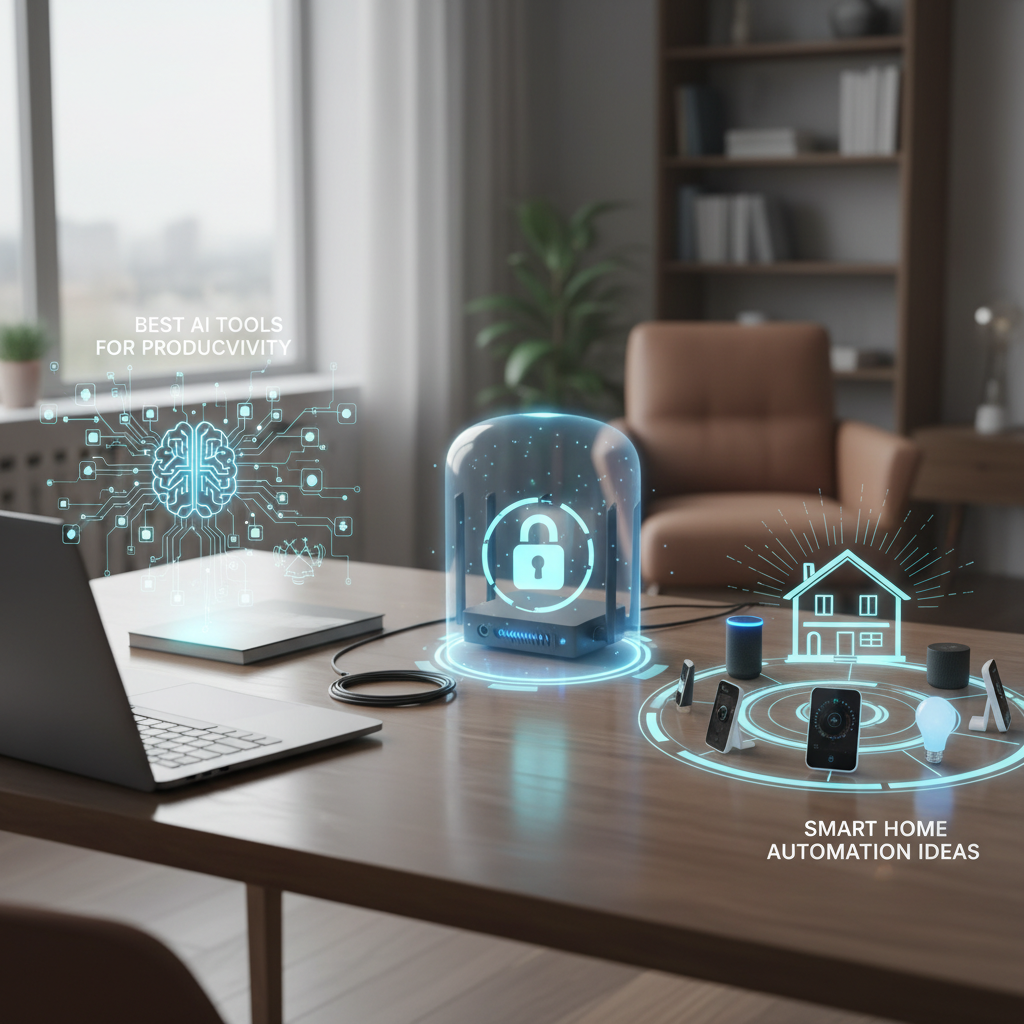
The best AI tools are quietly, yet fundamentally, reshaping our domestic lives. We’re moving beyond just shouting commands at a speaker; we’re building predictive, secure, and incredibly productive environments. This isn’t about chasing the latest shiny gadget; it’s about crafting a home that truly responds to your family’s unique rhythms, secures your digital footprint, and actually anticipates your needs. This guide? It’s your blueprint for building that integrated ecosystem.
The AI Engine: More Than Just a Voice Assistant
Look, let’s be honest. The beating heart of a truly modern smart home isn’t that sleek thermostat on the wall, and it’s certainly not the voice assistant that can tell you a joke. Those are just the front doors, the user interfaces we interact with. The real revolution is happening silently, often in the cloud and sometimes right on local processors, powered by an AI engine that does far, far more than simply listen for commands. For too long, we’ve been conditioned to think of smart tech as reactive—you speak, it acts. But the future, and frankly, the present for anyone building a truly intelligent home, is profoundly proactive. It’s about a home that anticipates, not just obeys.
Consider your energy bill for a moment. A basic smart thermostat just reacts to the current temperature. An AI-powered one, though, operates on pure prediction. It’s ingesting real-time weather forecasts, meticulously learning your family’s daily comings and goings, and can even monitor dynamic energy pricing from your utility provider. So, it doesn’t just flick on the AC when it gets hot; it might pre-cool the house an hour before that expensive peak-rate period even begins. That saves you money while maintaining perfect comfort. This is where things get a bit trickier, however. The system is essentially making a calculated bet on your behavior. If you decide to come home early one day, you might find yourself walking into a house that’s warmer than you’d like, simply because its predictive model was based on your typical routine. The convenience is truly immense, but it undeniably relies on the subtle predictability of your life.
And this proactive intelligence stretches far beyond just the thermostat. We’re now seeing generative AI—yes, the same technology powering tools like ChatGPT—making its way right into our kitchens. Imagine an AI that not only knows exactly what’s in your smart fridge but can then generate a week’s worth of meal plans based on those ingredients, your specific dietary preferences, and even what’s currently on sale at the local grocery store. It’s not just retrieving a recipe; it’s genuinely creating a solution. This often pairs beautifully with analytical AI that quietly optimizes your everyday routines. It notices you invariably turn on the coffee maker and the morning news at 6:30 AM, and eventually, it just does it for you. What’s often overlooked here is that these are some of the best AI tools for productivity, subtly applied to your personal life. They streamline those small, everyday frictions so you can truly focus on what really matters. The most profound automations aren’t the flashy party tricks; they’re the invisible ones that give you back five minutes here, ten minutes there.
Most folks assume that simply buying a few smart devices is all it takes to achieve this level of intelligence. But the reality is, a truly intelligent home isn’t just a collection of connected devices; it’s an integrated ecosystem where the real value comes from how those devices share data and learn from one another—a process that is, admittedly, far from seamless today. The hidden truth of the modern smart home is that its intelligence is directly proportional to the quality and diversity of the data it can access. And this creates a fundamental tension: for your home to become smarter and more helpful, you have to grant it increasingly deeper access to your life, from your calendar to your location data. This integration is perhaps the biggest hurdle, as the market is still a patchwork of competing standards and walled gardens, making the dream of a unified “home brain” feel more like a dedicated DIY project than something you just pick up at a retail store.
Ultimately, this shift fundamentally redefines our relationship with our living space. Your home is transitioning from being a passive shelter into becoming an active partner. It’s an environment that learns your rhythms, manages its own resources (like energy and water), and quietly works to simplify your life in the background. The goal isn’t just to build a home with a fancy remote control, but to cultivate a space with an ambient intelligence that operates with you, and truly for you. Finding the best AI tools for productivity isn’t just something for the office anymore; it’s about transforming your home into a powerful platform that genuinely supports your well-being and efficiency. The AI engine, then, is the essential foundation for this profound shift, turning a mere collection of gadgets into a cohesive, responsive system.
Real-World Automation: From Smart Lighting to Intelligent Workflows
So, we’ve talked about the “brain” of your smart home—that AI engine that processes information instead of merely reacting to it. But what does that actually look like, practically speaking? It’s far more than just telling a speaker to play a song. The real magic truly happens when multiple devices work together in expertly orchestrated workflows that solve tangible, everyday problems. This is the point where your smart home finally graduates from being just a collection of cool gadgets to a genuinely intelligent environment. Most people grab a few smart plugs and a camera, and then they stop there. But the genuine, lasting value is found in weaving them all together.
Let’s tackle a problem many of us now face: creating a true sanctuary for deep, focused work at home. This is precisely where you can build an “Uninterrupted Focus” scene—honestly, one of the best AI tools for productivity you can craft yourself. When you trigger it (maybe with a simple voice command or by tapping a smart button right on your desk), it’s not just flipping a “do not disturb” sign. Oh no, the AI initiates a meticulously choreographed, multi-step workflow. Your office lights might subtly shift to a cooler, focus-enhancing temperature. Your smart speaker then clearly announces to the entire house, “David has started a focus session,” ensuring the family knows not to interrupt. All smart displays in your vicinity automatically silence their notifications. And, perhaps most critically, your network management AI can prioritize bandwidth directly to your work computer, intelligently deprioritizing streaming services or game consoles for the duration. What’s often overlooked is that the single biggest productivity killer isn’t the notification itself, but the immense mental cost of context-switching. This automation is specifically designed to prevent that break in flow, creating both a digital and physical bubble that fiercely protects your attention.
Next, let’s reinvent a true classic: the “Welcome Home” routine. Most people assume this just means turning on the entryway light when you walk through the door. But that’s a simple automation, not an intelligent one. An AI-driven “Adaptive Welcome” is far more nuanced, far more responsive. It leverages multiple data points to understand the context of your arrival. Using your phone’s location, a smart camera’s facial recognition, and the time of day, the house can react in profoundly different ways.
- You arrive home alone after 7 PM on a weekday? The system thoughtfully assumes you’ve had a long day. It softly turns on a few warm lights in the entryway and living room, gently adjusts the thermostat to your preferred evening temperature, and maybe even starts a calming playlist on a speaker at a low, unobtrusive volume.
- The whole family’s phones arrive at the exact same time on a Saturday afternoon? The house immediately knows it’s a group arrival. It activates a brighter, more lively lighting scene, disarms the security system automatically, and perhaps even announces, “Welcome home, everyone!” on the smart speakers.
Now, this all sounds pretty incredible, right? But here’s the inherent tension point: this level of deep personalization demands that you feed the system a constant, intimate stream of data about your habits, your location, and even precisely who you are. The trade-off between seamless convenience and personal privacy becomes very real, very quickly. You’re not just programming a device here; you’re essentially teaching an entire ecosystem about the most intimate patterns of your life. This profound shift from simple manual commands to predictive assistance, all based on your personal data, truly is the defining trend in modern smart home technology.
Finally, let’s consider a “Pre-emptive Security” workflow that goes well beyond basic alarms. A hard truth about home security is that the biggest risks often stem from simple human error, not malicious intruders. So, this automation is specifically designed to catch those very mistakes. For instance, the AI notices the garage door has been left open for 20 minutes, and the sun has already set. It also confirms, via motion sensors, that there’s been absolutely no activity in the garage. Instead of just sending a generic, easily-missed notification, the AI takes initiative. It might flash the interior garage lights a few times, send a critical alert that bypasses your phone’s silent mode, and immediately display the live garage camera feed directly on your TV or primary smart display. People often think smart security is solely about catching a burglar in the act, but in reality, its greatest value lies in preventing the vulnerability from even occurring in the first place. This is one of the best AI tools for productivity and genuine peace of mind, as it effectively offloads the mental burden of constantly checking on things. The limitation, though, is that no algorithm is truly perfect. A poorly configured routine could trigger incredibly annoying false alarms, swiftly transforming your helpful assistant into a digital nuisance.
These examples reveal a much broader shift in how we interact with our living spaces. We’re moving away from a traditional command-and-control relationship with our devices and toward a more collaborative, ambient intelligence where the home actively anticipates our needs. The workflows themselves—that focus scene, the adaptive welcome, the pre-emptive alert—are increasingly becoming the product. But for any of this to work reliably, from the simplest command to the most complex AI-driven scene, everything depends on one single, absolutely critical foundation: the network. If your digital backbone isn’t secure, stable, and genuinely robust, none of this intelligent automation is possible. In fact, it can quickly become a liability.
Your Fortress: A Critical Home Network Security Guide for Connected Living
After weaving together all those intelligent automations—from lights that greet you to a coffee pot that practically knows your schedule—it’s easy to feel like you’ve finally arrived in the future. But with every new smart plug, camera, and sensor you lovingly add, you’re unknowingly expanding the attack surface of your digital life. Each of those devices, often built with convenience as the first priority and security as an afterthought, becomes a potential doorway. Your home is no longer just a collection of gadgets; it’s a complex, bustling network, and it’s high time we started treating its security with the seriousness it truly deserves.
Most of us operate under a comforting illusion: that a strong Wi-Fi password is like a high, impenetrable castle wall. The reality, unfortunately, is far more porous. What’s often overlooked is that the greatest threat isn’t someone guessing your password; it’s a vulnerability lurking in that obscure, no-name smart bulb you bought online for ten bucks. Hackers don’t need to break down your front door if you’ve left a hundred tiny windows wide open. The hidden truth of the modern smart home is that your security is only as strong as its weakest, cheapest, and most forgotten device. This dramatically changes the entire game from simple password protection to active, vigilant network defense.
The first crucial step in building your digital fortress is truly understanding the role of a modern firewall. Think of it less as a simple gatekeeper just checking IDs and more as an intelligent customs agent, meticulously inspecting every bit of traffic that flows in and out of your network. But a firewall alone can’t fully protect you from a device that’s already inside. The real tension point in smart home security is constantly balancing the incredible convenience of interconnectedness with the undeniable risk of a single compromised device infecting everything else. A compromised security camera, for instance, should absolutely not be able to talk to the laptop where you do your online banking. It just shouldn’t.
This is precisely where a concept that sounds complex—network segmentation—becomes incredibly simple and powerfully effective. Here’s where common expectations often get challenged. Instead of having one big, flat network where every single device can see every other device, you smartly create separate, isolated zones using something called VLANs (Virtual Local Area Networks). It’s essentially like building digital walls right inside your home.
- The IoT Zone: All your smart plugs, bulbs, cameras, and thermostats live here. They can talk to the internet, but crucially, they can’t see your personal devices.
- The Personal Zone: This is specifically for your trusted devices—your laptops, phones, and tablets.
- The Guest Zone: A temporary, isolated network for visitors that gives them internet access and absolutely nothing more.
Setting this up means that if a hacker somehow compromises your smart fish tank thermometer (and yes, that bizarre scenario has actually happened), the damage is completely, utterly contained. They’re effectively trapped in the IoT zone, entirely unable to access the sensitive data stored on your laptop. This one strategy dramatically reduces your overall risk without sacrificing a single bit of the functionality of your smart devices. It’s a fundamental shift from a traditional perimeter-based defense to a far more resilient, compartmentalized one.
But how do you even spot a threat that’s already lurking inside one of those zones? That’s where AI truly enters the picture, not just as a tool for convenience, but as a silent, ever-vigilant guardian. AI-powered threat detection systems, often seamlessly built into modern prosumer routers and dedicated security appliances, are an absolute game-changer. Instead of just looking for known viruses, they spend their time learning the normal, subtle rhythm of your specific network. They create a precise behavioral baseline. So, it knows your smart fridge usually downloads a tiny bit of data for updates and that your security camera sends a steady stream of video to the cloud. When that fridge suddenly tries to connect to a server in Eastern Europe, or your smart plug inexplicably begins uploading massive amounts of data in the dead of night, the AI immediately flags it as a serious anomaly. These systems are truly some of the best AI tools for productivity because they automate the tireless, always-on job of monitoring, skillfully turning petabytes of network data into a simple, actionable alert.
Now, here’s where things get a bit more complicated. Implementing this level of security isn’t some plug-and-play affair. The hard truth is that absolute security is a myth; the realistic goal is intelligent risk reduction. This demands more sophisticated hardware than the free router your internet provider likely gave you, and a genuine willingness to step into those settings and move beyond the defaults. It’s a clear trade-off: you’re exchanging a bit of initial setup complexity for long-term peace of mind. Many people assume this requires a deep technical background, but thankfully, the market is responding with increasingly user-friendly interfaces that thoughtfully guide you through the process, making robust security more accessible than ever before.
Ultimately, this approach represents a much bigger shift in how we absolutely must think about our connected homes. Your home network is no longer a simple utility just for getting online; it’s the central nervous system of your entire daily life, inextricably entwined with your work, your finances, and your family’s precious privacy. As we integrate some of the best AI tools for productivity and automation deeper into our lives, securing the network that supports them ceases to be an optional extra for tech enthusiasts. The truly intelligent home of the future won’t just be defined by its clever automations, but by its unparalleled ability to transparently and proactively defend itself from the inside out.
The True Impact: How the Best AI Tools Reshape a Typical Day
After discussing the critical importance of your home’s digital foundation, it’s easy to get a little lost in the technical weeds of firewalls and encryption. But what does a truly intelligent, AI-driven home actually feel like? The answer, surprisingly often, isn’t what you might expect. It’s not about talking to a robot in every single room. No, the true impact is found in the quiet, seamless anticipation of your needs. So, let’s walk through a day where the best AI tools aren’t just present, but fully, beautifully integrated.
The morning begins not with a jarring, obnoxious alarm, but with light. At 6:45 AM, the bedroom blinds slowly, gently tilt open, letting in the soft, angled morning sun. The color temperature of the overhead lights subtly mimics this natural dawn, gradually shifting from a warm, comforting orange to a soft, bright white. Most people still imagine a smart home is all about barking commands: “Hey, turn on the lights!” But the reality of a truly cohesive system is often characterized by silence. It simply knows it’s a weekday, understands the family’s typical wake-up schedule, and initiates the “Morning” scene without a single word. But today, it does something quietly different. It cross-references the family’s shared calendar, sees the entry for “School In-Service Day,” and intelligently holds the routine. The house stays delightfully quiet and dim for another hour. This isn’t just automation; it’s profound contextual awareness. The system isn’t just mindlessly following a command; it’s making a subtle judgment call, freeing up valuable mental energy that would have otherwise been spent overriding a dumb timer. These are, without a doubt, the best AI tools for productivity because they proactively eliminate friction you didn’t even know you had.
By 9:05 AM, the house is completely empty. As the last phone disconnects from the home’s Wi-Fi and the front door’s smart lock securely engages, the “Away” mode flawlessly activates. The thermostat dials back to an energy-saving temperature, all non-essential lights are confirmed off, and the security system arms itself. This, admittedly, is pretty standard fare. What’s often overlooked, though, is what the AI does next. It’s not passively waiting for a breach. No, the system immediately begins its own routine, running a quick diagnostic on all sensors and randomly cycling a few interior lights on a learned, natural-looking schedule to convincingly simulate occupancy. It’s a subtle but profoundly significant shift from a merely reactive security system to a truly proactive deterrence strategy. What was once a collection of disconnected sensors is now an expertly orchestrated defense network.
Around 2:00 PM, an external camera detects a delivery truck pulling up. The old way: a generic motion alert buzzes annoyingly on your phone. The new way: the AI’s sophisticated computer vision identifies the logistics company logo on the truck. It recognizes the driver’s uniform as consistent with previous deliveries and notes the person is carrying a package. So, instead of sending a panic-inducing “Person Detected” alert, the notification is incredibly specific: “FedEx delivery at the front porch.” For a moment, the system even creates a temporary, geographically-fenced “safe zone” around the porch, intelligently ignoring the driver’s motion within that ten-foot space to avoid false alarms while it confirms the package drop-off. Herein lies the central tension of the modern smart home: this incredible convenience is built upon a level of surveillance that demands both profound trust and an impeccably secured network. The benefit of granular, intelligent alerts is directly, undeniably tied to the risk of a highly monitored environment.
The return home in the evening is where the system’s predictive power truly shines. Geofencing notes the family car is ten minutes away, automatically triggering the “Arrival” sequence. The HVAC system quietly starts bringing the main floor to a comfortable 71 degrees, the entryway lights gently fade on, and the smart speaker begins playing a low-volume evening playlist. This sounds absolutely perfect, but here’s where things get a bit more complicated. What if one person comes home unexpectedly early, perhaps on their bike? The system, still tuned to the car’s signal, is caught completely flat-footed. The hard truth about the current generation of home AI is that it excels at predictability but can be surprisingly brittle when faced with spontaneity. It’s a sophisticated pattern-matching engine, not a truly conscious entity, and its intelligence is only as good as the routines it has painstakingly learned.
Ultimately, a day like this reveals that the real goal isn’t to build a “smart home” full of gadgets you constantly have to interact with. No, the true evolution is toward ambient computing—an environment where the technology recedes almost entirely into the background, serving you without ever demanding your direct attention. You’re no longer managing a dozen separate apps for your lights, security, and climate control. Instead, a central intelligence is expertly orchestrating them all based on context, learned patterns, and even your biometrics. This represents a fundamental shift from a home you constantly command to a home that genuinely understands and anticipates. The true measure of its success, funnily enough, is how little you actually have to think about it.
The Future Home: Ambient Computing and Ethical Considerations
After seeing just how deeply AI can reshape a single day, it’s easy to imagine the next logical step. We’re moving beyond actively using smart gadgets and hurtling toward a future defined by something called ambient computing. This, truly, is the endgame for the smart home: an environment where the technology is so utterly integrated that it becomes invisible, seamlessly woven into the very fabric of your walls, your furniture, and your appliances. The goal isn’t just to respond to your commands anymore. No, it’s to predict your needs even before you’re consciously aware of them. Your home won’t just be smart; it will be truly perceptive.
The promise here is absolutely intoxicating. Imagine a living space that adjusts the lighting and temperature based on your biometric data, sensing you’re stressed and subtly creating a calming atmosphere. Or a kitchen that thoughtfully suggests recipes based on the ingredients you actually have, your precise health goals, and the exact amount of time you have available, then automatically preheats the oven. Most people picture this as a perfectly seamless, utterly friction-free existence. The reality, however, is far more complex. What’s often overlooked is that this “magic” isn’t true understanding; it’s incredibly sophisticated pattern recognition. The system isn’t thinking, it’s meticulously calculating probabilities based on a massive history of your every action, and it can get things wrong in very human ways.
And this, quite naturally, leads us to the unavoidable tension at the very heart of the truly intelligent home: the trade-off between ultimate convenience and absolute transparency. For your home to know you well enough to anticipate your every need, it must, by definition, become the most effective surveillance device ever created. It’s not just listening for a wake word; it’s analyzing the subtle tone of your voice. It’s not just tracking when you leave; it’s monitoring your heart rate via connected devices and learning your precise sleep patterns. This deeply personal data is the essential fuel for the entire system, and the question of who owns, controls, and ultimately benefits from that information is one we are woefully unprepared to answer on a societal level. It’s a profound benefit-versus-risk scenario playing out in the most private of spaces imaginable.
Here’s where things get even more complicated, moving well beyond simple privacy into the critical realm of algorithmic bias. An AI, after all, is only as good, and as fair, as the data it’s rigorously trained on. So, what happens when your home’s AI starts making subtle assumptions? Perhaps it notices a slight decline in your activity levels and then begins to subtly curate a more sedentary environment—dimming lights earlier or suggesting more movies. Does it learn to associate certain types of music or particular accents with negative responses and then quietly filter them out? This might sound a bit dystopian, but it’s a genuine, tangible risk when we delegate complex decisions to non-human systems. Ultimately, the home’s AI doesn’t truly know you; it knows a statistical model of you, and that model can very easily reinforce existing biases or create unsettling feedback loops that nudge your behavior in ways you never intended. This is the hidden truth of predictive AI: its primary goal is efficiency, not necessarily your holistic well-being.
What all this undeniably points to is a fundamental shift in our relationship with our living spaces. Your home stops being a passive shelter and becomes an active participant—a genuine partner, of sorts—in your life. It subtly influences your routines, shapes your habits, and mediates your entire experience of the world. In a very real way, the home itself becomes one of the best AI tools for productivity, quietly optimizing your life for efficiency, for health, or for whatever goals its programmers—or you—have thoughtfully set. But this profound new relationship demands a new kind of literacy from us. We must learn to critically question its suggestions, understand its inherent limitations, and fiercely retain our own autonomy in the face of its powerful, often persuasive intelligence. The challenge, then, is ensuring the home remains a truly empowering tool for the human, and not the other way around.
As we stand right on the cusp of this future, the conversation needs to move well beyond just features and capabilities. We absolutely must start asking harder, more probing questions:
- Accountability: Who is truly responsible when a predictive AI makes a harmful error, like failing to detect a critical medical emergency or unintentionally creating a biased living environment?
- Control: How can users meaningfully maintain control and the crucial ability to override the system when its predictions are unwanted, or simply just wrong?
- Transparency: Will we have the fundamental right to see and understand the data and the underlying logic that lead our homes to make certain decisions on our behalf?
These aren’t just technical problems to be solved by clever code; they are profound ethical dilemmas that demand our careful attention. Developing the best AI tools for productivity and security in the home of the future will require more than just brilliant engineering. It will demand a deep, unwavering commitment to designing systems that are not only incredibly intelligent but also deeply respectful, genuinely transparent, and fundamentally aligned with core human values.
Conclusions
Ultimately, the smartest home isn’t the one crammed with the most gadgets, nor is it the one that responds to every voice command. No, it’s the one where AI, intelligent automation, and robust security are seamlessly, invisibly integrated. Moving forward, our focus absolutely must be on creating a truly cohesive ecosystem—one that is not only highly efficient and incredibly convenient but also fundamentally, unshakeably secure. This strategic, thoughtful integration isn’t just a trend; it’s the undeniable, true future of domestic technology.

Senior technology analyst covering enterprise software, AI, and digital transformation. James has spent over a decade helping business leaders understand how emerging tech reshapes competitive strategy.